
Transcript
Dr. Lim:
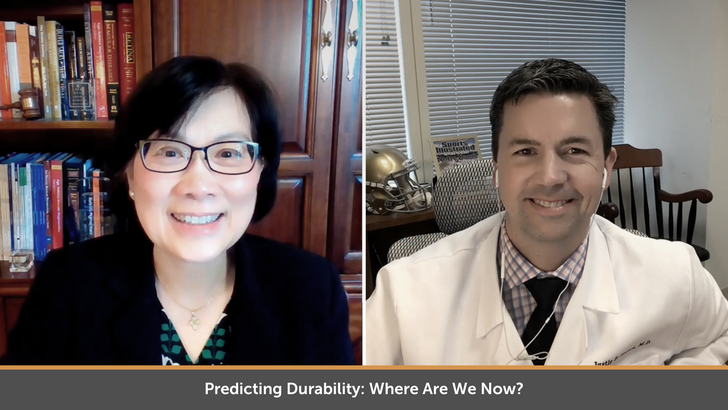
This is CME on ReachMD. I'm Jennifer Lim, and I'm joined by Justis Ehlers today.
We all want the longest dosing interval possible for our patients and, Justis, are there ways to predict which patients will respond well to treatment after the loading phase?
Dr. Ehlers:
Jenny, it's really great to be here, and I think it's a very exciting and important discussion, particularly as we have more and more treatment options to consider as retina specialist today.
Dr. Lim:
We saw that in the LUCERNE study that absence of intraretinal fluid and subretinal fluid by the end of the loading dose phase correlated with Q16-week dosing. And in fact, if patients had resolution at the end of this dosing phase, they were more likely to stay on longer dosing intervals.
When we look at the YOSEMITE and RHINE data, we also see that being treatment-naïve, having a lower baseline CST, and greater CST reductions at the end of the loading phase also resulted in the chances that they would more likely be able to be dosed on longer dosing intervals. Lastly, when we looked at PHOTON, it was shown that patients with greater CRT at baseline were more likely to need more frequent injections.
So a lot of this really mirrors what, intuitively, we would sense. Right? Thicker retinas, worse visual acuity, less response early, are more likely to need more injections. And, conversely, those that have an early treatment response, better visual acuity, drier retinas, are more likely to have better outcomes and require less frequent dosing.
Dr. Ehlers:
Yeah, it's interesting, Jenny, because I often like to pretend that I can predict what is going to happen with any given treatment. And I find that even with the clinical trial data that we have at the individual patient level, it’s still incredibly challenging to know how someone's going to respond. I find that it may be even more so in wet AMD, compared to DME. Wet AMD can be so much more of an acute process that I do feel like we often will see these really robust responses. Where with DME, we may be waiting longer. And I think one of the challenges as we get more and more durable therapy, is how do we continue to individualize this for our patients. Can we extend people out faster? What are the potential implications for that?
We know based on these clinical trials, that we see noninferiority of visual acuity with those rapid extensions. But again, at that individual patient level, if we’re avoiding things like fluid oscillations, that may be really important to maximize vision. I think we have some really great opportunities, things like home OCT, to understand fluid dynamics. Artificial intelligence is likely to have a bigger and bigger role in how we make these decisions. Even looking at images at the beginning, before we even treat, to decide this. But right now, we don't have a great way to do that and it's really trying to identify what is your therapeutic of choice for a given patient in front of you.
Dr. Lim:
I agree, and I think home OCT is going to be one that will allow us to personalize this treatment, so that for that particular patient, we can follow them and extend as long as we don't see a significant amount of fluid. And I think that's really the only way that we are going to be able to do this safely and with some precision.
Dr. Ehlers:
Yeah, the home OCT side of this really, could allow us to do very rapid treatment extension that's very tailored and very safe in the sense that, as soon as they begin to rebound, we could get those patients back in versus potentially waiting 3 or 4 weeks until they might be coming in for their next appointment.
I think one of the challenges that we do run into is our payers. Right now, we have a number of different treatment options, but many times as providers, we're not able to pick the treatment that we think is best for the patient in front of us. We sometimes have to go through multiple different steps of treatment failure before we get to treatment success, which may have important implications for overall visual outcomes for our patients.
Dr. Lim:
Justis, I couldn't agree with you more. I think we need personalized treatment and, unfortunately, insurances do dictate how many treatments we can give and when we can switch to more durable agents. Hopefully in the future, AI will be able to help us predict which patients will require more durable therapies and help inform our decision-making upfront.
So, unfortunately, that's all the time we have today. Thank you so much, Justis, for joining us today, and thank you to our audience for listening.
Dr. Ehlers:
Thank you, Jenny. It's been a pleasure.


